 |
|||

|  |

|
|
U.S. dairy industry innovates and expands to meet demand boom
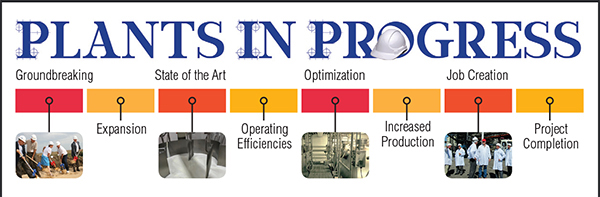
Editor’s note: Plants in Progress is a special segment spotlighting new facilities and expansion in the U.S. dairy sector — from initial groundbreaking to full operation and everything in between.
By Alyssa Mitchell
MADISON, Wis. — As the annual spring flush of milk production approaches, there will be additional capacity to take on milk to convert to nutritious cheese and dairy products as several dairy facility expansions are set to come online over the next 12 months and beyond.
From bite-sized snacking cheese to beloved yogurt brands to sweet frozen novelties, the U.S. dairy industry is responding to increased consumer demand for protein-forward foods by investing in additional capacity, sustainable systems, increased efficiencies and state-of-the-art equipment.
Several of these projects are assisted by state and federal funding as government officials recognize the value in investing in nutritious dairy products that feed families and communities. After all, it takes a village to feed a village, and staying on the edge of the latest technological advancements in milking systems, manufacturing and building efficiencies wouldn’t be possible without the support of these companies; their contractors; federal, state and local entities; and, of course, consumers.
Beyond world-class facilities and innovative, high-quality products, these projects are creating new jobs in their communities as well, from the workers on the ground to the managers in the plants to the executives in the offices.
From coast to coast, from the mountains of the West to the windswept plains to the bustling hubs of major cities, demand for protein is booming, and dairy reigns supreme as a nutritional powerhouse.
Please read on for more on these Plants in Progress ...
• Agropur, Lake Norden, South Dakota; and Little Chute, Luxemburg and Weyauwega, Wisconsin
Agropur is investing a total of $130 million in improvements underway at its facilities in Wisconsin and South Dakota.
In South Dakota, Agropur has committed to a $60 million project that will modernize the dryer at its Lake Norden plant. This project will allow Agropur to reposition its portfolio toward value-added products, such as whey proteins and milk concentrates.
In Wisconsin, Agropur is moving forward on a $70 million project at its plants in Weyauwega, Luxemburg and Little Chute that will increase whey processing and valorization capacity.
• Associated Milk Producers Inc., Blair and Portage, Wisconsin
Associated Milk Producers Inc. (AMPI) recently announced it will transition production at its Blair, Wisconsin, cheese plant from Cheddar to cottage cheese.
The transition will include a period of production downtime, with completion expected in the fourth quarter of this year and regular operations resuming thereafter. AMPI is working with impacted employees to provide access to resources, training and opportunities to apply for jobs at other AMPI facilities.
Milk from AMPI member farms will be routed to surrounding plants during the downtime. Customer orders will continue to be filled by other AMPI cheese plants.
Cottage cheese produced at AMPI’s Blair facility is fully committed. The plant is designed to be one of the largest cottage cheese producers in the United States.
Meanwhile, AMPI also is in the final phase of a rebuild of its cheese processing and packaging plant in Portage, Wisconsin, following a January 2023 fire. The team is ready to see production restored to pre-fire levels. The project remains on track with anticipated completion date in the second quarter of this year.
As part of the rebuild, AMPI is taking the opportunity to further strengthen the facility by investing in the improvement of plant design to enhance production efficiency, process flow and product quality. Updates include expanded space for packaging and production, along with infrastructure improvements such as HVAC, flooring, air handling and ammonia system upgrades to support long-term performance.
|
| Photo courtesy of Bel Brands |
| LAUGHING COW LINE — Bel Brands has invested in a new production line for The Laughing Cow brand in its Little Chute, Wisconsin, plant. |

• Bel Brands, Nampa, Idaho; Brookings, South Dakota; and Little Chute, Wisconsin
Bel Brands is investing in several of its facilities across the United States.
Last year, the South Dakota Board of Economic Development approved funding for an expansion at Bel Brands’ facility in Brookings, South Dakota. The company was approved for a REDI (Revolving Economic Development and Initiative) loan of up to $10 million to construct an additional 100,000 square feet of space, doubling its current production capacity at the Brookings plant. The company plans to hold a groundbreaking ceremony this month to kick off this project. Bel earlier in 2025 also announced a $200 million factory expansion at the Brookings plant that would increase its Mini Babybel production capacity by 10,000 tons annually.
Meanwhile, the company has invested nearly $20 million in a new production line for The Laughing Cow in Little Chute, Wisconsin, which is up and running. Bel Brands also is investing in its Boursin production capabilities, enhancing operational flexibility and efficiency.
Bel Brands also recently made an investment of approximately $130 million in Nampa, Idaho, to double production capacity of GoGo squeeZ products.
These investments are expected to create approximately 250 jobs across the United States.
• BelGioioso Cheese, Campbell and Glenville, New York
New York Gov. Kathy Hochul last fall announced that BelGioioso Cheese will upgrade and expand operations in New York state. The company is investing over $23 million at its facilities in Glenville and Campbell, committing to creating at least 30 new jobs between the two sites. In addition to the direct job creation goals, this expansion also will see the utilization of an additional 100 million pounds of milk from New York state’s dairy farmers. Empire State Development has agreed to support the project with up to $1.5 million in performance-based Excelsior Jobs Program tax credits.
“This decision by BelGioioso to further expand its operations upstate marks yet another chapter in New York’s agricultural success story,”
Hochul says. “New York’s dairy industry serves as a crucial economic engine for our state, and we are grateful to this successful company for its continued commitment to these communities, and to area dairy farmers, who always work hard to help position our state as one of the nation’s top dairy producers.”
In 2020, BelGioioso Cheese completed construction on a $25 million, 96,000-square-foot cheese plant in the Glenville Business and Technology Park in the Capital Region. The Glenville campus includes a manufacturing plant, and a distribution center built in 2022 — both of which will continue to facilitate growth. Schenectady County Metroplex Development Authority has agreed to provide a $150,000 capital grant to support this project, and a sales tax exemption for construction materials and supplies.
In 2021, the company purchased the Polly-O brand and its plant in Campbell in the Southern Tier of New York. The Campbell facility was constructed in 1938 and as part of this project is undergoing upgrades to its existing infrastructure and continuing modernization efforts, including the addition of product lines to allow continued growth. The Steuben County Industrial Development Agency
is providing assistance for the project. Now underway, the upgrades at both facilities are expected to be completed by late 2027.
“New York state plays a vital role in our success, and this investment reflects our commitment to the local communities, dairy farmers and team members who help us craft our specialty cheeses every day,” says Polly-O General Manager Timothy Cronin. “The Polly-O brand has a long and meaningful history in New York, and the Auricchio family has been dedicated to traditional cheesemaking for generations. The quality of milk produced in New York and the strong support from State and local partners make it possible for us to continue growing our operations here.”
|
| Photo courtesy of Bongards Creameries |
| BIGGER AND BETTER — Bongards Creameries is nearing completion on a $125 million plant expansion at its Perham, Minnesota, facility. Total square footage of the plant after the updates is 288,000 square feet. |

• Bongards Creameries, Perham, Minnesota
Bongards Creameries is nearing completion on a $125 million plant expansion announced in 2023 at its Perham, Minnesota, facility. The expansion/modernization project included new cheese vats, a new whey pasteurizer, a new permeate evaporator, a new milk intake and a new deproteinized whey dryer/permeate packaging system/permeate warehouse. Many facets of the expansion already are in operation.
Justin Larson, chief operating officer of Bongards Creameries, says the facility currently is processing almost 5.5 million pounds of per day.
“We built a new permeate dryer, took the old one down and will be commissioning a new whey protein concentrate dryer in June of this year,” Larson says.
Equipment that was not replaced has been expanded by 30% to handle the additional volume the company will be running through the plant once the project is complete.
Total square footage of the plant after the updates is 288,000 square feet.
|
| Photo courtesy of Hayner Hoyt Corp. |
| MOVING ALONG — Progress is ongoing on Byrne Dairy’s Cortlandville, New York, expansion, which remains on track for completion this fall. |

• Byrne Dairy, Cortlandville, New York
Byrne Dairy last summer broke ground on the Byrne Cortlandville (BCV) expansion. The $120 million project will double the workforce and production capacity at BCV. It encompasses several phases. Byrne Dairy, based in Syracuse, New York, began expansion activities in Cortlandville in 2022, which the company considered Phase 1, according to documents provided to a Town of Cortlandville Planning Board meeting last year. Additional phases will add more than 200 new positions and will encompass expanded space, new equipment, improved traffic and product flow, and more.
According to Hayner Hoyt Corp., a construction company that has been tapped for the project, the exterior of Phase 2A — which includes the installation of interior piers of the foundations and insulated metal wall panels — now is fully enclosed, with interior finishes nearing completion. Significant progress also has been on the warehouse and truck loading dock addition. Meanwhile, steelwork for Phase 2B (excavation/foundations) is advancing steadily, as the project remains on track for a fall 2026 completion deadline.
BCV 2.0 will add over 3,000 pallet spaces, which will allow the company to continue to penetrate new markets and develop different formats for its products, Byrne officials say, noting the company is eagerly anticipating the expanded production capabilities of ultrafiltered milk, which has gone well beyond its expectations, as well as other innovative products that are still in the pipeline.
• Chobani LLC, Twin Falls, Idaho, and Rome, New York
Chobani LLC last year announced a $500 million expansion of its Twin Falls, Idaho, plant. The project will increase production by 50% and add over 500,000 square feet of new space. The expansion, anticipated to be operational later this year, is expected to create a minimum of 160 new jobs, officials say.
The expansion will bring the Twin Falls plant to 1.6 million square feet, featuring 24 production lines and employing over 1,200 people. The expansion also requires significant infrastructure improvements, including upgrades to the city’s water, wastewater and power systems.
Meanwhile, Chobani last spring broke ground on a new $1.2 billion, state-of-the-art plant in Rome, New York. Once home to the former Griffiss Air Force Base, the 150-acre stretch of land is being transformed into a thriving center of food production, enabling Chobani to keep up with soaring product demand and create a runway for new innovations. The 1.4-million-square-foot, multiyear project is expected to add over 1,000 full-time jobs with competitive wages, an attractive benefits package and access to a suite of on-site health and wellness amenities.
Company officials say they hope to receive their first milk into the facility by early 2027. Construction will last through 2026, and it will take several years for the facility’s seven production lines to become fully operational.
|
| Photo courtesy of Dairy State Cheese |
| STORAGE SILOS —Dairy State Cheese recently installed three new milk storage silos, each with a 70,000-gallon capacity, at its facility in Rudolph, Wisconsin, as part of ongoing capital improvements. |

• Dairy State Cheese LLC, Rudolph, Wisconsin
Dairy State Cheese continues to make strong progress on several major capital projects designed to expand production capabilities and support future growth. According to John Zirbel, chief operating officer-external manufacturing, installation of a new milk high-temperature short-time (HTST) system is underway and expected to come online soon, strengthening the Rudolph, Wisconsin, facility’s ability to efficiently process incoming milk.
The facility also recently installed three new milk storage silos, each with a 70,000-gallon capacity. With the addition of these silos, total on-site milk storage capacity has increased to 480,000 gallons, providing greater flexibility in milk handling and production scheduling.
In the make area, the new cheese belt system is nearing completion of the installation phase and soon will transition into commissioning as the team prepares it for full production, Zirbel notes. Additional improvements also are taking shape in the plant’s processing systems, with new membrane equipment nearing the end of installation and commissioning expected to begin shortly.
Meanwhile, recently installed Alfa Laval separators and clarifiers already are in service and performing exceptionally well in day-to-day operations, Zirbel says. Dairy State Cheese also is investing in environmental infrastructure with work underway on a new wastewater treatment plant. The new system will be a state-of-the-art facility designed and integrated by Complete Filtration, supporting sustainable operations as the plant continues to grow.
“These investments represent another step in the ongoing transformation of Dairy State Cheese,” Zirbel says. “As we continue to modernize the facility, each project is designed to strengthen our capabilities while operating to the most exacting industry standards for quality, efficiency and sustainability.”
|
| Photo courtesy of Ames Regional Economic Alliance |
| BOOMING IN BOONE —Daisy Brand LLC is investing more than $600 million in a new facility in Boone, Iowa. Demand for the company’s sour cream and cottage cheese products has created the need for additional manufacturing capacity, company officials say. |

• Daisy Brand LLC, Boone, Iowa
Daisy Brand LLC, manufacturer of one of the largest brands of sour cream and cottage cheese in the United States, held a ceremonial groundbreaking last year in Boone, Iowa. Demand for the company’s products has created the need for an additional manufacturing facility, company officials say.
Daisy is investing more than $600 million in a 750,000-square-foot to 1 -million-square-foot facility, creating 106 new jobs to start, a number anticipated to grow to 255 as demand increases. The Iowa Economic Development Authority (IEDA) board approved $7 million in direct financial assistance as well as tax benefits for the company.
Headquartered in Dallas, Daisy Brand is a fifth-generation family-owned company with existing operations in Texas, Arizona and Ohio. The decision to expand into Iowa was driven by several factors, including Iowa’s agricultural resources and strengths, favorable business environment and strategic location, officials say.
The new facility is located in the industrial park in Boone, Iowa, strategically chosen for its dairy resources and infrastructure. The plant will produce Daisy’s signature sour cream and cottage cheese.
Company officials say Daisy Brand hopes to have the new plant up and running by late 2028.
• Danone North America, Fort Worth, Texas, and Minster, Ohio
Danone North America plans to invest $4 million in a remodel and expansion of its yogurt facility in Fort Worth, Texas.
According to a recent filing with the Texas Department of Licensing and Regulation, the expansion will include 3,495 square feet of additions and the remodeling of 1,8434 square feet in its existing facility to accommodate new equipment. The project kicked off in January, with completion set for Sept. 1 of this year.
The Fort Worth facility produces Danimals Kids’ Yogurts and Smoothies, Activia Probiotic Yogurt and YoCrunch Yogurt with Toppings. Approximately 210 employees currently work at the 22,000-square-foot plant.
Meanwhile, last summer Danone announced the expansion of its Minster, Ohio, yogurt facility, which produces brands such as Oikos, Activia, Dannon and Danimals. The multimillion-dollar investment includes an approximately 48,000-square-foot facility expansion as well as a new production line and upgrades to existing lines, bringing 30 new full-time jobs to the region.
“Our commitment to American manufacturing runs deep, with 90% of our ingredients and packaging materials bought here,” says Dan Magliocco, president, Danone North America. “Fulfilling our mission to bring health through food to as many people as possible means producing nutrient-rich foods with U.S. ingredients in American factories that are benefiting local communities.”
Danone officials note the yogurt category is experiencing explosive growth driven by consumers seeking more nutrient-dense foods that are high in protein and rich in nutrients and probiotic benefits. This investment in the Minster yogurt facility offers expanded capacity to address that consumer demand. Danone will purchase 60% more milk for the Minster yogurt facility over the next couple years, which will include working with existing producer partners to increase their production and onboarding new local farms into the Danone family. For nearly a decade, Danone has partnered with dozens of farmers across the United States to source the ingredients that go into its products.
Danone’s enhanced facility also will create approximately 30 new, full-time jobs in Ohio’s Golden Triangle region — a hub of American manufacturing strength — with competitive wages and comprehensive benefits.
“We are excited to continue growing our team and presence in Minster, Ohio. This is the latest example of our 80-plus years of investments in American food, its economy and the farming partners that sustain our food systems — and this closely follows our recent investment in Jacksonville, Florida,” says Heiko Gerling, COO for Danone North America.
• Duchess Dairy, Rural Retreat, Virginia
Duchess Dairy recently completed an expansion of its dairy processing operations in Rural Retreat, Virginia. The family-owned and operated dairy manufacturer has grown its operation by adding a production line of churned butter in addition to its line of premium bottled milk.
“We would like to thank Gov. (Glenn) Youngkin, the state of Virginia, Wythe County and the town of Rural Retreat for their assistance with this project, as well as our many loyal customers for the purchase of our products,” says James Huffard III, president of Duchess Dairy.
The Virginia Department of Agriculture and Consumer Services worked with Wythe County and the town of Rural Retreat to secure the project for Virginia. Youngkin approved a $25,000 facility grant from the Agriculture and Forestry Industries Development Fund, which Wythe County matched with local funds.
• Edelweiss Dairy, Freedom, New York
New York Gov. Kathy Hochul late last year announced the commencement of construction on Edelweiss Dairy’s $34 million expansion in the Town of Freedom in Cattaraugus County. This development comes in response to increased demands from regional manufacturers, including fairlife and Wells Enterprises, officials say.
Empire State Development (ESD) awarded a $450,000 Excelsior Jobs Tax Credit contingent upon Edelweiss’s commitments to job retention and creation. In collaboration with the Cattaraugus
Industrial Development Agency, ESD also approved a reduced rate loan allocation of $8,403,214 from the State Bond Reserve.
Established in 1960, Edelweiss Dairy is a third-generation, family-owned dairy operated by John Gerard
Borer, his son John Michael Borer and daughter-in-law Bethany Borer.
With two additional farms in Arcade and Portageville, New York, Edelweiss constitutes a significant component of the local agricultural community, state officials say. (This is unrelated to Edelweiss Creamery in Wisconsin, which closed last year.)
“Our family takes pride in our longstanding contribution to this farm. We appreciate the support from Empire State Development, which enables us to fulfill increasing demand for our premium product and prepare for ongoing success,” says Edelweiss Dairy General Manager John G. Borer.
To enhance capacity and operational efficiency, Edelweiss Dairy will replace its current Freedom Farm facility. The expansion marks a transition to a modernized operation emphasizing automation, sustainability and herd care, aligning growth initiatives with environmental stewardship and resilience.
The multi-phase project reflects rising consumer demand with Phase 1 involving construction of one barn. Phase 2 represents further investment, establishing two new 1,500-cow barns, a state-of-the-art rotary milking parlor capable of processing up to 700 cows per hour, a 21-million-gallon lagoon with cover, electrical infrastructure upgrades, and an innovative manure and sand separation system enabling recovery of 90% of bedding sand and reducing annual diesel consumption by approximately 18,000 gallons. The project is expected to generate 25 new jobs with an average annual wage of $75,000.
• Grande Cheese, Chilton, Wisconsin
Progress continues on an expansion of Grande Cheese’s Chilton, Wisconsin, facility that it acquired from Foremost Farms in 2023. Grande Cheese, located in Southeastern Wisconsin, serves as a premier manufacturer of fine Italian cheeses and specialty whey and lactose products.
Grande Cheese is in the process of hiring for roles at the expanded facility.
“It’s been going great, and we’re really excited about that and the new talent from the area,” the company says, noting construction is progressing as planned, with some associates on-site getting the plant ready for making cheese, which it anticipates to ramp up by mid-2026.
Construction includes approximately 20,000 square feet of renovations and 60,000 square feet of new construction. The facility will be the third-largest in Grande’s network and primarily produce Mozzarella.
|
| Photo courtesy of Hightail |
| CAPACITY FOR CURDS — Natalie Paino recently began selling cheese curds made from milk from her family’s dairy farm in Plainfield, Iowa. |

• Hightail, Plainfield, Iowa
Natalie Paino, owner of Hightail, a dairy farm in Plainfield, Iowa, recently became licensed to sell cheese curds using milk from her family’s dairy farm. Prior to that, she was making ice cream out of a nearby assisted living facility as capacity was added to the farm to add cheese curds to its product lineup.
Paino notes federal and state grants helped to provide part of the funding to bring in shipping containers to the farm to allow for milking of its approximately 53 registered Holsteins, as well as cheesemaking and cold storage capacity. She recently obtained an additional shipping container that functions as a parlor.
Hightail hopes to add bottled milk to its product lineup later this year.
|
| Photo courtesy of Hiland Dairy Foods |
| IMPROVED LANDSCAPING — Exterior improvements, including sidewalks and landscaping, are underway at Hiland Dairy’s Tyler, Texas, facility as its expansion approaches final stages of construction. |

• Hiland Dairy Foods Co., Tyler, Texas
Hiland Dairy’s expansion at its Tyler, Texas, facility continues to progress on schedule toward a first-quarter 2026 completion, the company says. The 90,000-square-foot addition will expand processing, filling, casing, palletizing, storage and laboratory capabilities, supporting increased production and improved distribution across East Texas and surrounding markets.
The project has advanced into commissioning and start-up activities. Power has been made live to the site, interior lighting is operational in multiple areas, and mechanical, plumbing and electrical work continues to move toward final completion, officials say.
The project was designed by E.A. Bonelli Architects + Engineers and constructed by Big-D Construction.
• Ice Cream Factory, Lebanon, Missouri
Ice Cream Factory is advancing a major production and infrastructure expansion at its 90,000-square-foot historic dairy facility in Lebanon, Missouri, following its acquisition by PNC Brands Group LLC.
The initiative includes a fill line expansion, a tenfold increase in in-house bakery capacity, electrical modernization and development of a 22,000-plus pallet multi-zone frozen warehouse. Production upgrades are on track for full operational status by April/May 2026, officials say. The frozen warehouse expansion is scheduled to break ground in May.
The expansion reflects increasing retailer demand for vertically integrated frozen manufacturing partners capable of supporting national programs with in-house inclusion production and scalable cold storage, officials note.
Ice Cream Factory currently produces approximately 900 gallons per day, or roughly 5,000 pints of ice cream. With upgraded fill line installation and supporting electrical modernization, single-shift production capacity will increase to more than 70,000 pints per day.
The upgrade represents a more than 14-fold increase in daily production capacity and positions the facility to support national retail programs, co-manufacturing relationships and private label partnerships. The company also will offer multiple packaging formats designed for retail and foodservice channels, and is actively hiring for a second production shift following equipment installation. The company anticipates adding new roles across manufacturing, quality assurance, warehousing and logistics as capacity ramps in 2026.
“PNC Brands Group was attracted to this facility for its infrastructure and long-term expansion potential,” says Gail Kurpgeweit, founder and CEO of PNC Brands Group. “Our portfolio extends beyond ice cream, and relocating our distribution center to Missouri allows us to scale more efficiently across all product lines. Within the frozen category, emerging ice cream and novelty brands often face barriers due to high production and ingredient minimums. While we are significantly expanding high-capacity production, we are intentionally retaining our micro production line so seasonal programs, small-batch artisanal runs and emerging brands continue to have a manufacturing home here.”
• Lifeway Foods, Waukesha, Wisconsin
Lifeway Foods Inc., a U.S. supplier of kefir and cultured probiotic dairy products, late last year held a ribbon-cutting ceremony in front of Gertrude the Cow, the beloved landmark at Lifeway’s Waukesha, Wisconsin, facility. The event marked the launch of phase two of Lifeway’s four-phase, $45 million expansion project, a long-term investment designed to double overall production capacity, increase operational efficiencies, expand production hours and staffing, and solidify Waukesha’s position as the global hub of kefir production. Phase two focuses on installing a state-of-the-art cooling system to support Lifeway’s expanded fermentation and bottling operations.
Lifeway’s Waukesha facility transforms millions of gallons of Wisconsin-sourced milk each month into the company’s signature kefir, a tart and tangy cultured dairy beverage packed with protein, calcium and live probiotics.
This milestone follows the successful completion of Phase one, which doubled fermentation capacity by expanding the number of fermentation tanks used to culture Lifeway’s kefir. With each phase, the Waukesha facility moves closer to the company’s long-term goal of doubling total output by 2026 to meet surging global demand.
The Waukesha expansion represents Lifeway’s largest manufacturing investment to date. When fully complete, the project will enhance the company’s ability to deliver high-quality cultured dairy products worldwide while strengthening Wisconsin’s position as a cornerstone of America’s dairy and probiotic industries.
|
| Photo courtesy of Miller Family Dairy |
| NEARING COMPLETION — Progress continues on a major expansion of Miller Family Dairy’s facility in Montgomery, Alabama, expected to open later this year. |

• Miller Family Dairy, Montgomery, Alabama
Progress continues on a major expansion of Miller Family Dairy’s facility in Montgomery, Alabama.
The first-generation farm, which opened in 2020 as a raw milk operation, currently milks eight cows and plans to grow its herd to about 100. The Alabama Department of Agriculture and Industries awarded Miller Family Dairy $1.9 million through the USDA Resilient Food Systems Infrastructure (RFSI) program, which will allow the family to add pasteurization and begin producing value-added dairy products including butter and cheese.
“This grant opportunity completely changed everything for us,” says owner Jennilee Miller. “We saw an opportunity to not only expand into value-added dairy but also to support other dairy farmers in the area. According to the Dairy Alliance, only 16 dairy farms remain in Alabama. With our new facility, we hope to be able to change this.”
The project also will provide space and resources for future growth, including sourcing milk from additional dairies, creating jobs and offering educational opportunities to promote Alabama’s dairy industry.
The Miller Family Dairy facility is expected to open later this year. Once operational, milk, butter and cheese will be available in local grocery stores and directly from the farm.
• Sargento Foods, Plymouth, Wisconsin
Progress is on track for Sargento Foods’ new manufacturing facility announced last year. The project marks the largest investment in the company’s history to accommodate its ambitious growth plans.
Sargento purchased 66 acres of land on Highway 57 and County Road PP in Sheboygan County, Wisconsin, where the new plant will be located. The initial plan is to relocate manufacturing operations from its current Plymouth campus to this new 384,000-square-foot facility. Groundbreaking and construction are set to begin this spring. Completion of the project and phased occupancy is anticipated to begin in 2027.
The company says with a vision to be the most innovative, best-loved real food company, this investment also demonstrates its commitment to the community and the future.
“We take great pride in our community and Wisconsin — our home. This investment represents our commitment in Plymouth and our long-held belief of sharing our success with our stakeholders,” says third-generation Sargento Chairman and CEO Louie Gentine. “We’re excited for this new chapter for the Sargento family. We look forward to continuing our track record of industry-leading innovation in our hometown.”
This new facility will have the latest manufacturing technology and offer enhanced employee ergonomics. While the company does not anticipate new jobs to be created right away, this state-of-the-art facility will have more room to grow in the future.
• Sartori Co., Plymouth, Wisconsin
Sartori Cheese is investing in the future of its Sartori whey converting facility in Plymouth, Wisconsin, with a 68,000-square-foot expansion. Officials say the project supports Sartori’s mission of making the best cheese in the world while ensuring strong, family-supporting jobs with competitive wages and comprehensive benefits remain in the county.
Designed to support continued innovation and operational excellence, the expansion will create opportunities for meaningful careers and future workforce development.
Construction is underway, with expected completion in spring 2027.
• Savencia Cheese USA, Lena, Illinois
Illinois Gov. JB Pritzker and the Illinois Department of Commerce and Economic Opportunity (DCEO) last month announced that Savencia Cheese USA will expand its existing production facility in Lena, Illinois. The company plans to add a new production line as part of its capital investment, which will create 50 new full-time jobs while retaining 125 existing jobs.
“For decades, Savencia Cheese has been producing and perfecting its globally renowned cheeses in Lena. While Savencia is known around the globe for its world-class products, it is known here as a community fixture — and a longtime engine of jobs and economic opportunity,” Pritzker says. “Through competitive incentive programs, workforce development and our state’s robust business development efforts, Illinois supports job creators that invest back into their communities.”
Savencia’s investment was supported by the Economic Development for a Growing Economy (EDGE) program.
Laurent Marembaud, secretary general of Groupe Savencia, says the group is pleased to continue its investments in the Kolb-Lena facility — with the support of the state of Illinois — to locally produce the best natural cheeses for U.S. consumers.
Savencia Cheese USA, a subsidiary of the French company Savencia SA, acquired its Kolb-Lena facility in 1987. Savencia specializes in the production and distribution of high-quality specialty cheeses across the United States, offering a diverse range of cheese products that serve both gourmet and everyday consumers.
|
| Photo courtesy of Schreiber Foods |
| SUSTAINABILITY IN SHIPPENSBURG — Schreiber Foods Inc. plans to expand operations in Shippensburg, Pennsylvania. As part of the project, the company plans to update filtration and reclamation systems to lower overall water consumption. |

• Schreiber Foods, Carthage, Missouri; Shippensburg, Pennsylvania; Logan City, Utah; and Beloit, Wisconsin
Schreiber Foods late last year received official approval from the Shippensburg Borough Council for a conditional use application that paves the way for a $144 million plant expansion in Pennsylvania. Company officials say the investment will support Schreiber’s long-term goals to reduce water usage, increase yogurt production and grow its team with new full-time roles.
The approved plan includes an 18,000-square-foot addition to the south side of the plant in Shippensburg, a new 2,000-square-foot milk receiving dock and updated truck parking. Once complete, the expansion is expected to boost yogurt output by 100 million pounds annually and create approximately 50 new full-time positions.
Schreiber’s typical water usage is about 500,000 to 600,000 gallons per day—nearly a third of the borough’s daily municipal capacity of 2.5 to 3 million gallons. Company representatives emphasized that the expansion’s updated filtration and reclamation systems are intended to lower overall consumption while maintaining compliance with borough and Pennsylvania Department of Environmental Protection discharge standards.
Justin Townley, engineering leader for Schreiber Foods, notes the expansion is designed to comply with municipal infrastructure limits by incorporating water reclamation and wastewater reduction systems. He adds that the upgrades will allow the facility to expand without placing additional demand on water or sewer systems.
In February, Schreiber Foods shared it has made investments to expand operations in Utah and Wisconsin.
Briohn Building Corp. of Brookfield, Wisconsin, in October broke ground on a project for a Milwaukee development company that will lease space in Beloit, Wisconsin, to Schreiber Foods. It is a two-phase project with room to add another 200,000 square feet as Schreiber Foods grows into the space. Schreiber Foods entered into an agreement with Lyons Magnus to purchase the beverage plant in Beloit last year.
Meanwhile, the Utah Governor’s Office of Economic Opportunity (GOEO) announced it has awarded Schreiber Foods a post-performance tax reduction for an expansion in Logan City, Utah. The corporate incentive is part of the state’s Rural Economic Development Tax Increment Financing program.
“We’ve built a great connection with the people of Utah and Cache County, and that’s a big part of why we’re excited to keep growing here,” says Trevor Farrell, president of Schreiber Foods. “Our Logan and Smithfield teams bring so much pride and passion to everything they do. This expansion lets us build on that energy and keep moving forward together.”
Under the agreement, Schreiber Foods projects it will add 145 new, high-paying jobs and invest $165 million in Utah over the next eight years, GOEO says.
Meanwhile, in late 2024, Schreiber Foods announced a significant expansion in Carthage, Missouri, that will create new jobs, boost local economic growth and enhance Schreiber’s production capabilities so it can continue to be an essential ingredient in its customers’ success.
The expansion includes construction of a new 168,000-square-foot production facility that includes state-of-the-art technology. The $211 million investment is expected to create 150 new jobs.
The project will enhance Schreiber Foods’ process cheese capabilities in the United States and support the company’s ongoing efforts to partner with customers and meet increasing demand. Completion is expected in 2027.
• University of Idaho CAFE, Rupert, Idaho
Most buildings are now complete at the Idaho Center for Agriculture, Food and the Environment (Idaho CAFE), a University of Idaho-led facility in the Magic Valley that includes the nation’s largest research dairy.
John O’Connell, assistant director for communications at the university’s College of Agricultural and Life Sciences, says CAFE still is waiting on the addition of cows and has yet to announce an opening date, which will occur in 2026.
CAFE will open with a herd of 400 to 600 cows and gradually will grow to 2,000 to 2,500 cows.
The facility will achieve additional labor efficiencies through an automated crowd gate with a bar that will lower behind cows within the holding pen, slowly moving forward and guiding them through the parlor entrance.
Tour groups will be able to observe dairy operations through a window from atop a catwalk, maintaining a quiet atmosphere for cows.
The facility will provide research into challenges affecting Idaho dairies at an industry scale, making findings more applicable to their operations.
Mireille Chahine, a professor in the Department of Animal, Veterinary and Food Sciences, recently led a virtual tour of Idaho CAFE.
Meanwhile, in late 2025, USDA announced $3 million in federal funds toward building a cutting-edge nutrient-management facility at Idaho CAFE.
“We look forward to working with University of Idaho to build this research facility at Idaho CAFE,” says Dave Bjorneberg, supervisory research agricultural engineer at USDA’s Northwest Irrigation and Soils Research Unit. “The facility will allow researchers to evaluate technologies that will make dairy production systems more productive and profitable.”
USDA anticipates breaking ground on the nutrient-management facility in the spring of 2027 and completing it by late summer.
• Upstate Niagara Cooperative/UNC Dairy, West Seneca, New York
Construction is underway on a multimillion-dollar project that will significantly increase the size and capacity of Upstate Niagara Cooperative Inc./UNC Dairy’s West Seneca, New York, operations hub.
Upstate Niagara, headquartered in Lancaster, New York, has proposed a 165,000-square-foot addition to its existing 222,851-square-foot facility at 3300 North America Drive in West Seneca. Upstate Niagara is one of the anchor tenants of West Seneca’s North America Center corporate and industrial park.
Officials say the expansion will result in Upstate Niagara increasing its employment at the West Seneca site. The project will “add significant manufacturing capacity and storage of finished products,” the company says.
Within the expanded area, capacity will be devoted to manufacturing such products as milk, yogurt, sour cream and cottage cheese.
Officials say the expansion project should be completed by late 2026.
• V&V Supremo Foods, Jefferson, Wisconsin
V&V Supremo Foods, a family-owned producer of authentic Mexican cheese, chorizo and cremas, late last year announced the acquisition of 39 acres in Jefferson, Wisconsin, paving the way for a brand new, world-class production facility that will support the company’s capacity to meet the growing demand for V&V Supremo Foods’ products and bring more of its award-winning flavors to families across America.
Nestled between Madison and Milwaukee, Jefferson provides the ideal backdrop for expansion, V&V
Supremo officials say. Its thriving community, central location and access to major transportation corridors will enable V&V Supremo Foods to better serve retail and foodservice partners nationwide.
“This expansion reflects our confidence in the future and commitment to serving our consumers, retail, foodservice and industrial partners, and strengthening our ties with the communities where we operate,” says Gilberto Villaseñor II, chief visionary officer, V&V Supremo.
Designed with state-of-the-art manufacturing technology and sustainable practices, the plant will serve as a cornerstone for the company’s future while honoring its tradition of quality and authenticity. This new home represents exciting growth and symbolizes the company’s unwavering commitment to excellence, authenticity and tradition, officials say.
The expansion is expected to create new jobs and spark an economic impact in the region. V&V Supremo Foods says it looks forward to building strong partnerships with local and state partners to support training, workforce development and supplier relationships in the region.
• Walmart, Valdosta, Georgia
Walmart late last year celebrated the grand opening of its second owned and operated milk processing facility in Valdosta, Georgia — a major milestone that created more than 400 new jobs and strengthens Walmart’s end-to-end supply chain for affordable, high-quality milk and advances the company’s long-standing commitment to U.S. manufacturing and local sourcing. The 300,000-plus-square-foot, state-of-the-art facility represents a $350 million investment.
Sourcing milk directly from local dairy farmers, the Valdosta facility processes and bottles a variety of milk options — including gallon, half-gallon, whole, 2%, 1%, skim and 1% chocolate milk — for Walmart’s Great Value and Sam’s Club Member’s Mark brands. The new operation supplies more than 650 Walmart stores and Sam’s Clubs across the Southeast, helping ensure customers and members have consistent access to high-quality, affordable milk.
“This new facility has innovation at its core,” says Bruce Heckman, vice president, manufacturing, Walmart U.S. “It bolsters our capacity to meet the demand for high-quality milk, makes our supply chain more resilient and builds even greater transparency around sourcing. We’re excited about what this means for Walmart customers, regional farmers and the Valdosta community.”
Company officials say this milestone reinforces Walmart’s commitment to building a more transparent and efficient supply chain for dairy products, helping Walmart meet customer demand for high-quality, affordable milk across the Southeast. It follows the company’s investment in its first milk processing facility in Fort Wayne, Indiana, as well as two case-ready beef facilities in Thomasville, Georgia, and Olathe, Kansas.
|
| Photo courtesy of Wells Enterprises |
| WELCOME TO WELLS — Wells Enterprises began producing the first ice cream and novelty products at its state-of-the-art manufacturing facility in Dunkirk, New York, last fall as its second phase continues to progress. |

• Wells Enterprises, Dunkirk, New York
Wells Enterprises has continued expansion and reconstruction of its state-of-the-art manufacturing facility in Dunkirk, New York. Within the progress of Phase 1 of the project, the new plant began producing its first ice cream and novelty products in the fall of 2025, supported with the start-up of a one-of-a-kind chocolate facility dedicated to the production of ingredients for the company’s frozen treats.
“The excitement is growing among our team members. They’re already working inside Phase 1, which is in operation as we continue adding even more lines to the new facility,” says Lesley Bartholomew, director of institutional affairs for Wells Enterprises.
At the same time, Phase 2 of the project — which will include the construction of new office spaces, additional employee amenities, visitor entrances and completion of the primary exterior grounds and facade of the new building — also is in progress and on track for completion later this year.
The $425 million expansion project announced in 2024 continues to remain on track to support the company’s growth plans.
|
| Photo courtesy of Westby Cooperative Creamery |
| PROJECT PROGRESS— Members of the Westby Cooperative Creamery team meet with the company’s original equipment manufacturer partner, Nordic Dairy Technologies of Denmark, to discuss progress on Westby’s expansion project, slated for completion this fall. |

• Westby Cooperative Creamery, Westby, Wisconsin
Westby Cooperative Creamery last summer announced a $14.1 million investment to modernize the co-op’s manufacturing facility. The expansion project, which is expected to be complete this fall, includes a new food-grade room within the existing facility, the installation of four fully enclosed cottage cheese vats, two cream tanks, a new 30,000-gallon milk silo and upgraded refrigeration, sanitation and auxiliary equipment. It will increase cottage cheese production capacity by 50%.
According to Emily Bialkowski, sales and marketing manager for Westby Cooperative Creamery, the majority of the equipment has been ordered, and the first round of installations will begin this month, followed by a second round of major installations in May.
She adds that the project remains on schedule.
Meanwhile, late last year, USDA’s Rural Development Wisconsin State Director Andrew C. Iverson announced that Westby Cooperative Creamery is receiving a nearly $15.5 million loan from Rural Development Business and Industry Guaranteed Loan program and its partner bank, the Security Financial Bank, for the project.
“From a dairy farm to a grocers’ shelf, this investment will reinforce rural prosperity in Wisconsin,” Iverson says. “The Business and Industry Guaranteed Loan program is one of many Rural Development programs that support Wisconsin cooperatives. We are proud to support cooperatives, Wisconsin farmers, rural jobs and dairy production.”
CMN
| CMN article search |
   |
|
|
© 2026 Cheese Market News • Quarne Publishing, LLC • Legal Information • Online Privacy Policy • Terms and Conditions
Cheese Market News • Business/Advertising Office: P.O. Box 24 • Sun Prairie, WI 53590 • 608/831-6002
Cheese Market News • Editorial Office: 5315 Wall Street, Suite 100 • Madison, WI 53718 • 608/288-9090