Top Stories
U.S., China make progress on trade; Ibach gets nomination |
October 2, 2026 |
WASHINGTON — Last week, President Donald Trump and First Lady Melania Trump hosted China’s President Xi Jinping and his wife Peng Liyuan for a reciprocal state visit, where they discussed trade among other topics.
The two leaders operationalized the cornerstone government-to-government mechanisms of the U.S.-China Board of Trade and the U.S.-China Board of
Investment, which were chartered during the May 2026 Summit in Beijing.
Under the Board of Trade, the two countries reached consensus on recommendations for more favorable tariff treatment for $30 billion of non-sensitive goods in each direction. The Board of Trade also launched a working group focused on addressing market access barriers in the agricultural sector.
For U.S. exports, the goods include agricultural goods — primarily animals and meat — as well as fish and seafood, logs and wood products, cosmetics and medical devices. For U.S. imports, the goods include consumer products such as small appliances, toys, holiday decorations and children’s car seats.
According to several media reports, last week the United States and China also agreed to extend through Jan. 10 their trade truce or the “Busan Agreement” that had lowered tariffs and was set to expire in November. Meanwhile, China’s commerce ministry is extending two investigations it launched earlier this year into U.S. trade practices by three months.
In other trade news, this week Greg Ibach was nominated by Trump to serve as the next Under Secretary for Trade and Foreign Agricultural Affairs. If confirmed, he would succeed Luke Lindberg, who has been appointed as executive director of the United Nations World Food Programme.
Michael Dykes, president and CEO of the International Dairy Foods Association, welcomed Ibach’s nomination and urged the Senate to move swiftly to consider and confirm him.
“Greg brings a deep understanding of American agriculture and extensive experience advancing U.S. agricultural products in markets at home and abroad. His prior service as USDA Under Secretary for Marketing and Regulatory Programs, more than a decade leading the Nebraska Department of Agriculture, and firsthand experience as a farmer and rancher provide a strong foundation for this important role,” Dykes says.
“Expanding global markets is essential to the continued growth and competitiveness of U.S. dairy,” Dykes adds. “America’s dairy industry has more than doubled our exports over the past 10 years, and we are ready to serve growing demand around the world. We need strong leadership at USDA focused on opening new markets, removing trade barriers, and ensuring U.S. dairy products receive fair and reliable market access. We look forward to working with Greg to advance those priorities and strengthen opportunities for U.S. dairy exports.”
The National Milk Producers Federation (NMPF) and U.S. Dairy Export Council (USDEC) also welcomed Ibach’s nomination.
“As U.S. dairy farmers increasingly look to build international markets, USDA serves as a key resource to help our exporters meet global customers. Greg Ibach is a longtime leader in the agricultural industry and is an excellent choice to lead this important work. We look forward to working with him in this new capacity and urge a swift confirmation process in the Senate,” says Gregg Doud, president and CEO, NMPF.
“USDA’s role in facilitating dairy trade requires experienced leadership,” says Krysta Harden,president and CEO, USDEC. “Greg Ibach is the right choice to serve as Under Secretary for this critical work that dairy exporters rely upon. His impressive tenure as a leader at USDA and his firsthand experience as a farmer provides him with a valuable perspective to ensure that our producers’ interests are promoted on the international stage. We encourage the Senate to quickly advance his nomination.”
CMN |
|
Industry raises more than $47K at WDE dairy products auction |
October 2, 2026 |
MADISON, Wis. — Dairy industry stakeholders raised more than $47,000 at the 2026 World Dairy Expo (WDE) Championship Dairy Products Auction, held here
Monday evening on the WDE grounds at the Alliant Energy Center and hosted by the Wisconsin Dairy Products Association (WDPA).
While $46,650 was raised from bids on 26 lots of first-place products from this year’s World Dairy Expo Championship Dairy Products Contest, held Aug. 18-20 at Madison College, an additional $725 playfully was donated following the auction for three “butter squishies,” which were purchased by Excel Engineering ($250),
Compeer Financial ($200) and M3 Insurance ($275), bringing the evening’s total to $47,375.
A portion of proceeds from the auction go to students pursuing food or agricultural degrees at the University of Wisconsin-Madison, UW-Platteville, UW-River Falls, North Central Technical College and Madison College.
“We had a great crowd and a great time celebrating our winners and raising a lot of money to support scholarships for our next generation of dairy stars,” says Phil Plourd, executive director of WDPA. “It’s a privilege to partner with World Dairy Expo on this contest.”
Winning bids in each lot are as follows:
• Lot 1 — Kelley Supply purchased a combined lot of Cello Fontina made by Schuman Cheese/Lake Country Dairy, Turtle Lake, Wisconsin; Plain Cream Cheese made by High Desert Milk, Burley, Idaho; and Cotija Cheese made by V&V Supremo Foods, Chicago, for $2,400.
• Lot 2 — Kwik Trip purchased a combined lot of Plain Cheese Curds made by Nasonville Dairy, Marshfield, Wisconsin; Chocolate Peanut Butter Chipper made by Whitey’s Ice Cream, Moline, Illinois; 2% Small Curd Cottage Cheese made by Prairie Farms Dairy, Quincy, Illinois; and Know & Love Goat Cheese Crumbles made by The Winn-Dixie Co., Jacksonville, Florida, for $2,200.
• Lot 3 — Excel Engineering purchased a combined lot of Baby Swiss Cheese made by CROPP/Organic Valley, LaFarge, Wisconsin; Salt Kissed Ice Cream made by Kwik Trip, La Crosse, Wisconsin; and Lite Sour Cream made by Hiland Dairy, Omaha, Nebraska, for $1,050.
• Lot 4 — Nelson-Jameson purchased a combined lot of Super Premium Vanilla made by Kurschner’s Super Premium Ice Cream, Chetek, Wisconsin, and Non-Smoked Provolone made by Foremost Farms USA, Clayton, Wisconsin, for $1,000.
• Lot 5 — Excel Engineering purchased a combined lot of Super Gouda made by Marieke Gouda, Thorp, Wisconsin; Mango Lassi Frozen Yogurt made by Clementine’s Ice Cream, St. Louis; and White Extra Melt American With Jalapenos made by Land O’Lakes, Spencer, Wisconsin, for $1,900.
• Lot 6 — M3 Insurance purchased a combined lot of Mint Chip made by Chocolate Shoppe Ice Cream, Madison, Wisconsin; Mascarpone made by Crave Brothers Farmstead Cheese, Waterloo, Wisconsin; and String Cheese made by CROPP/Organic Valley, LaFarge,
Wisconsin, for $2,700.
• Lot 7 — Nelson-Jameson purchased a combined lot of Cheddar Cheese made by Southwest Cheese, Clovis, New Mexico; Chihuahua Cheese made by V&V Supremo Foods, Chicago; and Crema Mexicana made by Hiland Dairy, Norman, Oklahoma, for $1,950.
• Lot 8 — Masters Gallery Foods purchased a combined lot of Cheese Crafters Yellow Cheddar Cheese Cubes made by Winona Foods, Green Bay, Wisconsin; Pepper Jack Cold Pack Cheese Spread made by Pine River Pre-Pack, Newton, Wisconsin; and Blueberry Greek Nonfat Yogurt made by Upstate Niagara Cooperative, Lancaster, New York, for $2,200.
• Lot 9 — Kemps purchased a combined lot of S’more to Love made by Chocolate Shoppe Ice Cream, Madison, Wisconsin, and Vanilla Yogurt made by Old Home Foods, Bloomington, Minnesota, for $925.
• Lot 10 — Excel Engineering purchased a combined lot of Caves of Faribault AmaBlu Blue Cheese made by Prairie Farms Dairy, Davenport, Iowa; Vanilla Bean made by Clementine’s Ice Cream, St. Louis; and EM Strawberry Drinkable Yogurt made by Marquez Brothers International, Clewiston, Florida, for $900.
• Lot 11 — Lake Country Dairy/Schuman Cheese purchased a combined lot of President Rondele Mango Habanero Spreadable Cheese made by Lactalis American Group, Merrill, Wisconsin; Super Premium Chocolate Ice Cream made by Kurschner’s Super Premium Ice Cream, Chetek, Wisconsin; and Bison Sour Cream made by Upstate Niagara Cooperative, Lancaster, New York, for $1,410.
• Lot 12 — Hydrite purchased a combined lot of Sweet Spoonful Vanilla Mascarpone made by Schuman Cheese/Lake Country Dairy, Turtle Lake, Wisconsin; Karoun Village Touma made by Central Valley Cheese, Turlock, California; and Cookies & Cream Ice Cream made by Kwik Trip, La Crosse, Wisconsin, for $2,310.
• Lot 13 — Rosemary Raysor of Darigold Inc. purchased a combined lot of La Chona Chipotle Cream made by Mexican Cheese Producers-Sigma, Darlington, Wisconsin; 1% Cottage Cheese made by Hiland Dairy, Wichita, Kansas; Ghira Yummie made by King Cone LLC, Plover, Wisconsin; and Whole Milk Ricotta Cheese made by Lactalis American Group, Buffalo, New York, for $1,305.
• Lot 14 — Phil Plourd of WDPA purchased a combined lot of Cookie Butter Gelato made by Gelatissimo USA, Houston, and 80% Salted Butter made by Dairy Farmers of America, Winnsboro, Texas, for $1,500.
• Lot 15 — Galloway Co. purchased a combined lot of Aged Cheddar Cheese made by Land O’Lakes , Kiel, Wisconsin; Fresh Mozzarella-Ciliegine made by Crave Brothers Farmstead Cheese, Waterloo, Wisconsin; and Blueberry Yogurt made by Hiland Dairy, Wichita, Kansas, for $6,000.
• Lot 16 — T.C. Jacoby & Co. purchased a combined lot of Grade AA Cultured Butter made by Continental Dairy Facilities, Coopersville, Michigan, and 10% Plain Greek Yogurt made by Cabot Creamery Cooperative, Waitsfield, Vermont, for $1,000.
• Lot 17 — Nelson-Jameson purchased a combined lot of Cello Black Pepper Roasted Garlic Hand Rubbed Fontina made by Schuman Cheese/Lake Country Dairy, Turtle Lake, Wisconsin; Black Raspberry Chip made by Cedar Crest Specialties, Cedarburg, Wisconsin; and Ranch Dip made by Prairie Farms Dairy, Fort Wayne, Indiana, for $1,750.
• Lot 18 — Masters Gallery Foods purchased a combined lot of Muenster made by CROPP/Organic Valley Cooperative, LaFarge, Wisconsin; Classic Parmesan made by Sartori Cheese, Plymouth, Wisconsin; and Whole Milk Plain Original Yogurt made by Country View Dairy, Hawkeye, Iowa, for $2,500.
• Lot 19 — Kerry purchased a combined lot of High Protein Strawberry Ice Cream made by Hoffmann Oberweis Dairy, North Aurora, Illinois; 2% Small Curd Cottage Cheese made by Umpqua Dairy Products Co., Roseburg, Oregon; Cello Smoky Pepper Hand Rubbed Fontina made by Schuman Cheese/Lake Country Dairy, Turtle Lake, Wisconsin; and Low Fat Ricotta Cheese made by
Lactalis American Group, Buffalo, New York, for $950.
• Lot 20 — Galloway Co. purchased a combined lot of Roth Grand Cru Surchoix Wheel made by Emmi Roth, Stoughton, Wisconsin; Naturally Oven-Smoked Processed Gruyère made by Global Foods International, Schiller Park, Illinois; and Mango Dragon Fruit Sherbet made by Stewart’s Shops, Saratoga Springs, New York, for $2,800.
• Lot 21 — Excel Engineering purchased a combined lot of Strawberry Crème made by Clementine’s Ice Cream, St. Louis; EM Mango Drinkable Yogurt made by Marquez Brothers International, Clewiston, Florida; and Colby Jack made by Schnuck Markets Inc., St. Louis, for $500.
• Lot 22 — Winona Foods purchased a combined lot of Organic Sharp Cheddar made by Rumiano Cheese Co., Plymouth, Wisconsin; Vona Whole Milk Mozzarella made by Pennland Pure, Hancock, Maryland; and Black Walnut Premium Ice Cream made by Belfonte Dairy, Kansas City, Missouri, for $1,450.
• Lot 23 — Kemps purchased a combined lot of French Onion Dip made by Prairie Farms Dairy, Carbondale, Illinois; Super Premium French Vanilla made by Kurschner’s Super Premium Ice Cream, Chetek, Wisconsin; Whole Milk Strawberry Yogurt made by Old Home Foods, Bloomington, Minnesota; and Breakstone’s Whipped Butter made by Dairy Farmers of America, Winnsboro, Texas, for 1,700.
• Lot 24 — Cheese & Butter Grand Champion — Excel Engineering purchased BBQ Chip Cheese Curds made by Pleasant Lane Farms Creamery LLC, Latrobe, Pennsylvania, for $1,400.
• Lot 25 — Grade A Grand Champion — Nelson-Jameson purchased 10% Vanilla Greek Yogurt made by Cabot Creamery Cooperative, Waitsfield, Vermont, for $875.
• Lot 26 — Ice Cream Grand Champion — Nelson-Jameson purchased Yippee Skippee made by Chocolate Shoppe Ice Cream, Madison, Wisconsin, for $1,975.
CMN |
|
Law firm seeks comment on raw milk cheese FDA petition |
October 2, 2026 |
BAINBRIDGE ISLAND, Wash. — Food safety law firm Marler Clark Inc. this week opened a public comment period on a draft citizen petition asking FDA to require a warning statement on cheese made from unpasteurized milk.
“Every fact in this petition is footnoted, and most of the sources are FDA’s own,” says Marler Clark Managing Partner Bill Marler. “Before I ask the agency to act on it, I want the people who make, sell, regulate, treat the victims of and eat this cheese to tell me where it is wrong. I would rather fix it now than read the objection in the docket.”
Earlier this week, the Centers for Disease Control and Prevention (CDC) and FDA announced a multistate outbreak of Shiga toxin-producing E. coli O26:H11 linked to Graziers grass-fed raw milk cheese made by Sierra Nevada Cheese Co. of Willows, California.
As of Sept. 30, the outbreak includes 13 people sick in California, Colorado, Georgia, Kentucky, Michigan, Nevada, Oregon, Tennessee and Utah, eight hospitalized and three with hemolytic uremic syndrome, a form of acute kidney failure. More than half of the sick are 5 years old or younger. FDA contacted the company on Sept. 24, and the company recalled all four Graziers raw milk cheeses the same day (see related article on page 10 of this issue). The cheese was aged at least 60 days, as federal law requires of a raw milk cheese, and the package said so.
This week Marler Clark was retained by the family of a child who developed hemolytic uremic syndrome after eating Graziers raw milk cheese. The firm is not identifying the child. Marler also represents a claimant in the 2025 Twin Sisters Creamery raw milk cheese outbreak in Washington and Oregon; both representations are disclosed in the petition.
“A family bought a cheese whose label told them it followed the federal rule, and their child is in kidney failure,” Marler says. “The label did not tell them what FDA wrote in 2015: that the rule was presumed to control pathogens, that the data said otherwise, and that E. coli O157:H7 survives 60 days in Cheddar.
That sentence belongs on the package, and it is the only thing this petition asks a cheesemaker to add.”
Since 1987, FDA has prohibited unpasteurized milk in interstate commerce, with one exception the regulation itself calls an “alternative procedure to pasteurization” — cheese cured at least 60 days. Marler’s petition documents four E. coli outbreaks in 31 months linked to cheese that met that requirement, 43 people sick, 17 hospitalized and at least six children with kidney failure, and rests on the agency’s own record: the 2015 joint FDA/Health Canada risk assessment finding that 60 days of aging can increase listeriosis risk in soft-ripened raw milk cheese; the agency’s 2015 request for comment on the 60-day rule, which drew 75 comments and no proposed rule; FDA’s own sampling of 1,606 aged raw milk cheeses; and an FDA-funded Cornell University study published in Nature Medicine in October 2025 finding that 60 days of aging does not eliminate viable H5N1 avian influenza virus. It notes that California’s raw milk warning law, in force since 1991, expressly exempts cheese aged 60 days, and that Washington’s applies only to containers of milk.
The petition asks FDA to amend 21 CFR 101.17, the regulation that has carried the unpasteurized juice warning since 1998 and the shell egg safe handling statement since 2000, to require on cheese made from unpasteurized milk: “WARNING: This product is made from unpasteurized (raw) milk and may contain harmful bacteria that can cause serious illness in children, older adults, pregnant women and persons with weakened immune systems.”
It asks that cut-to-order cheese be covered by a counter placard, that imports be treated like domestic cheese and that online sellers display the statement; exempts cheese made from pasteurized milk or a validated equivalent process; and asks FDA to complete within a year the reevaluation of the 60-day rule it announced in 2013, and to publish the sampling data it already holds, including the 2025 H5N1 results promised for the spring of 2025 and never posted. It does not ask FDA to ban raw milk cheese, lengthen the aging period or restrict who may buy it.
Marler is asking for specific criticism on five questions, and for any factual error:
• Is the wording of the statement right? FDA’s juice warning names children, the elderly and people with weakened immune systems; the draft adds pregnant women and says “older adults.” Should it name the diseases?
• Is a point-of-sale placard workable for cheese cut and wrapped at a service counter, and should the retailer or the cheesemaker be responsible for it?
• Which validated processes should qualify for the exemption from the statement, and who should validate them?
• Is one year of placards before labels must change the right compliance period, or too long for public health or too short for a small farmstead cheesemaker?
• Is any count, date or quotation in the draft wrong? Each is footnoted so it can be checked.
The draft petition and request for comments are posted at www.marlerblog.com/case-news/raw-milk-cheese-needs-a-warning-label-here-is-the-fda-petition-i-plan-to-file-read-it-and-tell-me-what-i-got-wrong-before-i-do/.
Comments should be emailed to bmarler@marlerclark.com by Oct. 9. Marler will read all of them and may quote from comments in a follow-up post without attribution unless the commenter agrees to be named. Once the petition is filed, FDA will assign it a docket number on regulations.gov, where anyone may comment formally; the agency is required to respond within 180 days.
“I am not asking FDA to ban anything,” Marler says. “Adults who want raw milk cheese can keep buying it. I am asking for the sentence the government has put on unpasteurized juice for 28 years, and I am asking the people who know this product better than I do to help me get it right.”
CMN |
|
|
|
|
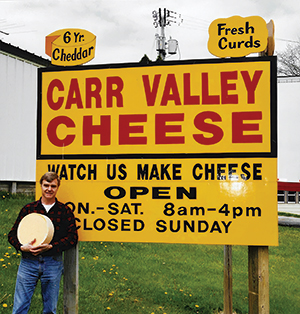
| Carr Valley celebrates 40 years of cheese innovation under the leadership of Sid Cook
LA VALLE, Wis. — Carr Valley Cheese, known for its many varieties of award-winning cow, sheep, goat and mixed-milk cheeses, this month is celebrating 40 years under the leadership of Wisconsin Master Cheesemaker Sid Cook.
Cook purchased Carr Valley Cheese in La Valle, Wisconsin, on Sept. 1, 1986. Over the next several decades, he expanded its production from making primarily 23-pound Cheddar daisy wheels to making more than 100 varieties, from aged Cheddars to creamy Blues to specialty butters.
“Instead of one product or one cheese, what we’re known for is innovation,” Cook says.
“We’re always innovating, and we have some things on the drawing board. There’s a new one we plan on doing next week or the week after — it should be an amazing product,” he adds.
As they celebrate their 40-year milestone this month, the cheesemaking legacy of Cook and Carr Valley Cheese started long before 1986. A fourth-generation cheesemaker, Cook grew up in his parents’ Irish Valley Cheese factory, which made raw milk cheeses with milk in cans until the late 1960s. The cheese vats were on the other side of the family’s kitchen door.
Click to continue reading... |
|
|
IWC conference looks at ‘The Whey Ahead’ for dairy proteins |
September 25, 2026 |
CHICAGO — The American Dairy Products Institute (ADPI), in partnership with the European Whey Processors Association (EWPA), welcomed whey industry professionals from around the world to Chicago this week for the 12th International Whey Conference (IWC), held Sept. 20-23.
The sold-out conference brought together whey processors, manufacturers, researchers, suppliers, customers and industry stakeholders for sessions focused on the science, innovation, markets and opportunities shaping the future of whey. The conference’s exhibit hall also sold out, underscoring the strong industry interest and engagement surrounding this year’s event, organizers say.
“The International Whey Conference is unique because it brings together the entire global whey community, from research and processing to applications, markets and the companies putting these ingredients to work,” says Patti Smith, president and CEO of ADPI. “To see a sold-out conference and exhibit hall, along with the level of engagement throughout the week, speaks volumes about the strength of this industry and the value of bringing people together to exchange ideas, build relationships and look ahead to what’s next for whey.”
Educational programming throughout IWC 2026 examined the opportunities and challenges influencing whey today and into the future. General sessions explored the current and future state of the global whey industry, sustainability, emerging technologies and feedstocks, regulatory developments and how whey ingredients are being used around the world. Dedicated nutrition and innovation tracks provided a deeper look at the latest research in protein and lipid nutrition, processing advances, functionality and applications.
In a presentation on how the United States is meeting growing demand for whey protein, Mike McCully, owner of McCully Consulting, noted the unprecedented amount of investment in milk processing and dairy proteins across the country. From 2025 and continuing through 2027, there have been and will be more than $13 billion in 40-plus new dairy plant investments, with multiple new cheese plants and expansions in the central United States, he said.
Looking forward, record-high whey protein prices will spur additional cheese production, along with conversions of lower-value whey products, like sweet whey powder and whey protein concentrate (WPC) 34% and 35%, to higher-value products like WPC 80% and whey protein isolate (WPI), he added.
From a global perspective, dairy economist Mary Ledman, publisher of the Daily Dairy Report, presented on meeting the challenges of changing global demographics, diets and supply chains. She highlighted several examples of vertical integration among U.S. dairy companies as well as global examples from China, Russia and Saudi Arabia.
Cross-border partnerships and acquisitions also have presented new opportunities, Ledman added, citing Southwest Cheese, which began as a joint venture between Ireland-based Glanbia plc and U.S. dairy cooperatives Dairy Farmers of America and Select Milk Producers. Another example included the acquisition of Wisconsin Whey Protein by Dutch-based FrieslandCampina, a strategic move that allows the co-op to scale and expand its market position in Europe and Asia into the North American market.
Meanwhile, Scott Dicker, senior director and head of research and insights for SPINS, presented on how the “whey boom” is signaling where the market is headed. He noted that protein is top of mind for today’s consumers, and products are becoming format-flexible, expanding usage occasions beyond traditional sports nutrition.
He adds that even with shortages and pricing struggles in the whey market, whey remains at the top in terms of growth, with whey protein powder leading the charge.
In addition to the various presentations throughout the conference, industry executives took the stage late Monday morning for a leadership panel moderated by Smith and featuring Luis Cubel, CEO of Arla Foods Ingredients; Maxime Devourdy, president, ingredients and corporate strategy, for Agropur Canada; Scott Graham, chief operating officer of Hilmar; and Benno Van Mersbergen, director of whey partnerships for FrieslandCampina, providing perspectives from across the international dairy ingredients sector.
IWC 2026 also put emerging researchers in the spotlight through its Early Career Researcher Award competition. Eleven early career researchers were selected to participate in the Poster Competition, providing an opportunity to showcase new research, exchange ideas with fellow scientists and connect directly with professionals from across the global whey industry.
Beyond the educational program, IWC provided numerous opportunities for attendees to connect with colleagues, customers and industry partners throughout the conference.
One of the week’s signature networking experiences took attendees beyond the conference hotel for a dinner cruise on Lake Michigan. Attendees enjoyed an evening on the water and views of the Chicago skyline while continuing the conversations and relationship-building that are central to the IWC experience, organizers say.
The global whey community will come together for the 13th International Whey Conference, set for Sept. 17-20, 2028, at the De Doelen convention center in Rotterdam, the Netherlands.
CMN |
|
Higher-component herds take in bigger milk checks: report |
September 25, 2026 |
DENVER — For decades, milk volume was the primary measure of dairy performance. Higher rolling herd averages and larger milk tanks generally meant higher revenue.
That equation is changing, notes a new report from CoBank’s Knowledge Exchange authored by Corey Geiger and Abbi Groves.
As consumer demand shifts from milk toward cheese, whey, butter and other manufactured products, the value of milk increasingly depends on its butterfat and protein content. Under multiple component pricing (MCP), those components now are major drivers of milk check revenue.
CoBank’s analysis of seven federal milk marketing orders (FMMOs) using MCP shows how much money is at stake. At average U.S. milk production, herds in the top 10% for component performance earned $101 to $352 more per cow annually than herds in the bottom 10%. At a 90-pound tank average, the advantage grew to $136 to $474 per cow.
For a 1,000-cow dairy, that difference can represent hundreds of thousands of dollars in annual milk check value.
U.S. milk is becoming richer in valuable components, the report notes. From 2011 to 2025, national butterfat increased from 3.71% to 4.32%, a gain of 0.61 percentage points. Protein increased from 3.08% to 3.32%, a gain of 0.24 percentage points.
The change is even more apparent when looking at pounds produced. From 2010 to 2025, U.S. milk production increased 18.4%, while protein production rose 27.7% and butterfat production jumped 34.6%.
In other words, dairy cows are producing more valuable solids without a proportional increase in milk volume, the report says.
The report demonstrates the Upper Midwest FMMO averaged 4.37% butterfat and 3.33% protein in 2025. But the difference between high- and low-component herds was significant.
The top 10% averaged 4.44% butterfat and 3.38% protein, compared with 4.16% and 3.23%, respectively, for the bottom 10%.
At average U.S. production of 24,390 pounds per cow annually, that difference translated into about $0.70 more per cow per day in butterfat and protein value for the top group, assuming equal milk volume, the report says.
At a 90-pound tank average, the advantage increased to approximately $0.95 per cow per day, or $345.58 per cow annually. That equates to about $34,558 for a 100-cow dairy, $345,582 for a 1,000-cow dairy and more than $3.45 million for a 10,000-cow dairy.
Top Upper Midwest herds producing 90 pounds of milk per day now average about 7 pounds of combined butterfat and protein — up from roughly 6 pounds a decade ago.
Meanwhile, the financial opportunity differs substantially among FMMOs because component levels vary from one herd to another, the report says.
The Mideast order had one of the narrowest butterfat spreads. Top-decile herds averaged 4.35%, compared with 4.24% for the bottom decile.
The Southwest showed the widest spread: 4.52% for the top decile versus 4.07% for the bottom — a 0.45-percentage-point difference.
Protein showed similar variation. The Pacific Northwest had the widest protein spread, with top-decile herds averaging 3.51% compared with 3.28% for the bottom decile.
Those differences translate directly into milk check value. At average U.S. production, Mideast top-decile herds had a $101.44-per-cow annual advantage over the bottom decile. In the Southwest, the advantage was $352.22.
At 33,000 pounds of annual milk production, those figures increased to $136.62 and $474.39 per cow, respectively.
For a 1,000-cow Southwest dairy, the latter represents nearly $474,000 in annual component value.
The industry’s traditional focus on milk volume remains useful, but it no longer tells the entire revenue story, the report says.
For producers paid under MCP, pounds of butterfat and protein increasingly deserve to be tracked alongside milk production. Useful measures include pounds of butterfat per cow, pounds of protein per cow, combined component pounds and component value per cow.
Processors are also creating additional incentives for valuable components. Some pricing programs now incorporate products such as whey protein concentrate and whey protein isolate, further increasing the economic value of protein production.
The broader trend is clear: U.S. dairy cows are producing milk with more valuable solids, and those components are becoming increasingly important to farm revenue, the report says.
At the current pace of improvement, U.S. milk could approach 5.0% butterfat and 4.0% protein before 2035.
The key question for dairy producers therefore is evolving from “How much milk does the cow produce?” to “How much valuable component does she produce — and what is it worth?” the report concludes.
To read the report, visit www.cobank.com/knowledge-exchange/higher-component-herds-capture-bigger-milk-checks.
CMN |
|
August milk production is up 1.8% in 24 major U.S. states |
September 25, 2026 |
WASHINGTON — Milk production in the 24 major milk-producing states in August totaled 19.17 billion pounds, up 1.8% from August 2025’s 18.83 billion pounds, according to data released this week by USDA’s National Agricultural Statistics Service (NASS). July revised production for the 24 major states was 19.30 billion pounds, a decrease of 100 million pounds or 0.5% from the previous month’s preliminary production estimate. (All figures are rounded. Please see CMN’s Milk Production chart.)
For the entire United States, August milk production was estimated at 19.90 billion pounds, up 1.7% from August 2025’s 19.56 billion pounds.
August production per cow in the 24 major states averaged 2,070 pounds, up 4 pounds from August 2025 and down 17 pounds from July. For the entire United States, production per cow in August is estimated at 2,049 pounds, down 1 pound from August 2025 and down 19 pounds from July.
NASS reports the number of milk cows on farms in the 24 major states was 9.26 million head in August, up 151,000 head from August 2025 and up 15,000 head from July. In the entire United States, there were an estimated 9.71 million head in August, up 167,000 head from August 2025 and up 15,000 head from July.
California led the nation’s milk production in August with 3.39 billion pounds of milk, down 0.7% from August 2025. Wisconsin followed with 2.83 billion pounds of milk produced in August, up 1.5% from August 2025.
CMN |
|
Spot NDM, whey prices surge as protein demand persists |
September 18, 2026 |
By Alyssa Mitchell
MADISON, Wis. — Spot prices for nonfat dry milk (NDM) and dry whey at the CME have surged in recent weeks due to domestic and international demand for high-protein products that is tightening supply and diverting milk into more value-added commodities, market analysts say.
Spot CME NDM has been in the upper $1.80- to $1.90-per pound range in recent weeks, surpassing the $2 mark earlier this week. NDM settled at $2.08 per pound today, up 68 cents per pound from the mid-year low point of $1.40 seen back in July.
In its latest Global Dairy Commodity Price Forecast Report released this week, HighGround Dairy notes that after the first significant rally earlier in the year for NDM — driven by a supply crunch of limited production and stockpiles combined with several FDA recalls — market demand appeared satiated, and prices pulled back. However, prices began to rise again into the latter part of the year as demand surged once again — yet this time, the need for product is outpacing even elevated production.
USDA’s Dairy Market News this week notes that the market tone for low/medium heat NDM in the Central and East is described as firm.
“Production of low/medium heat NDM is limited, and inventories remain tight throughout the Central and East regions. Market participants indicate that spot loads are available in the West at comparatively lower values, though overall West pricing is higher. Demand is steady and contacts report that buyers are securing only near-term needs, hedging on the potential of lower prices in upcoming weeks,” Dairy Market News says.
Growing consumer demand for high-protein products like ultrafiltered (UF) milk, cottage cheese, yogurt and milk powders also is diverting skim solids away from dryers and into those products, says Betty Berning, contributing dairy economist, HighGround Dairy.
“It seems like skim solids are headed elsewhere — not NDM dryers — and that is a big reason for the run-up in prices,” Berning says, adding that NDM availability east of the Rockies has been tight throughout 2026.
Mike McCully, owner of McCully Consulting, notes that skim milk powder (SMP) prices have rallied to multiyear highs on Global Dairy Trade (see related article on page 18 of this week’s issue) while U.S. prices have returned to a premium over global prices.
“In the U.S., supplies have been tight for most of the year,” McCully says. “When prices dipped in July, export interest picked up and sales were booked for shipments to Southeast Asia and Mexico. Once again, manufacturers were sold out and prices have rallied back over $2. The market is expected to remain tight into 2027 given strong demand for skim milk in other products.”
However, at these price levels, buyers may begin to pull back, analysts say.
“The NDM market has been volatile to say the least, with such intense price swings making forecasting price direction incredibly murky,” HighGround says. “Global powders prices are also following the NDM market higher but are driven by other factors such as weather and the ever-growing El Niño risk in the Pacific. High prices may deter further export opportunities while greater production should help to alleviate supply concerns heading into the fourth quarter and early 2027.”
Kathleen Noble Wolfley, vice president, insights, at Ever.Ag, says she is skeptical that NDM prices will stay above $2 for the long term.
“You’ve got New Zealand product coming online as they ramp up their seasonal production. I think buyers will back off as you see these higher prices hold. There’s likely a correction coming at some point, though I don’t know the severity. I would be surprised if we hold above $2 for the remainder of the fourth quarter,” she says.
Meanwhile, spot CME dry whey settled at $0.78 per pound today, its highest price since November 2025.
“Export interest from Asian buyers continues to improve. Dry whey production in the Central region is generally steady, though some processors are curbing output as they prioritize higher whey protein concentrate (WPC) manufacturing,” Dairy Market News says. “Animal feed whey prices are unchanged, and market participants note that values remain competitive with other dairy-based feed ingredients. Production schedules are light overall, contributing to tighter inventories in the region.”
Despite the higher U.S. dry whey price, European whey is even more expensive, HighGround Dairy notes.
“Since the first quarter, European whey prices have exceeded U.S. prices. Arid conditions played a role here, too, as cheese vats have slowed on the continent, meaning the whey stream has shrunk. These tighter supplies are likely driving the higher prices,”
HighGround Dairy says.
As a result of the United States’ price advantage, dry whey exports have rocketed higher and in July broke the 30-day adjusted record, totaling 60.9 million pounds, up 76% year-over-year, HighGround Dairy adds, noting that while China is importing less whey due to a reduction in its hog herd, it has drastically increased its buying of U.S. product.
Berning notes that high-protein WPCs and whey protein isolates (WPIs) are supporting dry whey prices, adding that there is the potential for some continued upside to the dry whey market.
“Dry whey might still have a little oomph left,” she says, adding, however that “in the whey complex, we’ve seen WPC80 and WPI prices pull back, so demand destruction may be occurring, which would cause dry whey to decline, too.”
While whey protein prices have set new record highs this year, signs of demand erosion have appeared over the last two months in the WPC80 market as prices have slipped in recent weeks, McCully notes.
“WPI prices remain firm given less elastic demand than WPC80. WPC34 prices have jumped to record highs in the last two months, but on a protein basis, remain well below WPC80,” he says. “Plants that have the ability to either dry WPC34 or sell liquid WPC can make more money just selling the liquid. The carbohydrate portion of whey has also seen price increases with CME sweet whey hitting the mid-$0.70s on good export demand — July shipments were record large. With higher European prices and continued export demand, U.S. prices are forecast to be steady to higher into the fourth quarter.”
CMN |
|
Farm bill passes out of Senate Agriculture Committee by 12-11 |
September 18, 2026 |
WASHINGTON — U.S. dairy and agricultural stakeholders expressed appreciation for progress on the farm bill this week as the Senate Agriculture Committee advanced the Agricultural Act of 2026 out of committee on a 12-11 party-line vote on Wednesday. The action moves the legislation to the full Senate for consideration as Congress works toward completing a new farm bill before the current extension expires Sept. 30. Bringing the bill out of committee now triggers a conference committee between the version passed by the Senate Ag Committee and the House version, which was passed in April.
“Farm country is hurting and needs results now,” said Senate Ag Committee Chair John Boozman, R-Ark., following the vote this week. “Advancing this bill out of committee is a critical step toward getting a fully updated farm bill signed into law. While this is clearly welcome progress, we need more of our colleagues’ votes to reflect the urgency of supporting farmers, ranchers, forest landowners and rural communities. I will always stand with the families who feed America and the world. They continue to have my commitment on getting bipartisan Farm Bill 2.0 across the finish line.”
Michael Dykes, president and CEO of the International Dairy Foods Association (IDFA), says IDFA commends Chairman Boozman and members of the committee for their leadership and work to deliver a new five-year farm bill, including provisions important to the dairy industry such as the Dairy Nutrition Incentive Program and other key dairy programs.
“We urge the full Senate to take up the farm bill without delay and encourage senators on both sides of the aisle to come together around a path that can earn bipartisan approval,” Dykes adds. “America’s dairy industry, farmers and families need the certainty of a new five-year farm bill, and (this week)’S action brings us meaningfully closer to that goal.”
National Milk Producers Federation President and CEO Gregg Doud echoed this sentiment.
“With a farm bill already through the House, we’re hopeful that both chambers can now work together on full congressional passage in 2026 that gives dairy farmers the certainty they deserve,” Doud says.
The Wisconsin Cheese Makers Association (WCMA) notes that the Senate committee’s bill includes several priorities WCMA has advocated for throughout the farm bill process.
“The committee’s bill contains meaningful investments in the future of dairy — from innovation and nutrition to exports and risk management,” says Rebekah Sweeney, WCMA senior director of programs and policy. “These provisions can create new opportunities for dairy farmers and processors while strengthening rural economies.”
Priorities in the bill passed this week championed by WCMA include:
• $36 million for the Dairy
Business Innovation Initiative (DBII): The bill authorizes $36 million annually for DBII, supporting dairy businesses with innovation, value-added production, business development and market expansion. The Dairy Business Innovation Alliance, operated by WCMA and the Center for Dairy Research, has provided nearly $24 million in grants to dairy businesses across an 11-state region.
• Mandatory dairy cost surveys: The bill establishes mandatory cost and yield surveys that will provide updated information to help inform future improvements to federal dairy policy and milk pricing.
• Dairy forward pricing: The legislation extends the Dairy Forward Pricing Program, providing dairy farmers and handlers with an additional tool to manage price risk.
• Codification of the term “natural cheese”: Establishing a clear statutory definition will provide greater consistency and clarity for dairy manufacturers and consumers.
• Dairy nutrition incentives: The bill expands dairy participation in nutrition incentive programs, including the Healthy Fluid Milk Incentive and Dairy Nutrition Incentive Program, helping increase access to and consumption of nutritious dairy foods.
• Trade and market development: The legislation includes continued support for programs that help U.S. agricultural products compete in international markets, including the Market Access Program and Foreign Market Development Program. It also includes protections for common food names in trade agreements.
The committee’s consideration also included continued debate over proposed changes to the Supplemental Nutrition Assistance Program (SNAP). The Senate proposal would require states to share in certain SNAP costs when payment error rates exceed specified thresholds, WCMA notes. Boozman
offered a one-year delay to the provision to address concerns raised by committee Democrats, but that delay also would increase the state cost-share in many cases, and that move failed to garner bipartisan support.
“Dairy businesses depend on a strong farm bill that supports innovation, expands market opportunities, strengthens risk management and helps our industry remain competitive in an ever-changing global marketplace,” Sweeney says. “We appreciate the committee’s action to move this important legislation forward and encourage lawmakers to continue working together to deliver a comprehensive farm bill.”
Jaime Castaneda, executive director of the Consortium for Common Food Names (CCFN), notes that for decades, the European Union (EU) has tried to monopolize common food names like “parmesan,” “bologna” and “chateau,” turning generic terms into exclusive EU property and locking American producers out of markets they helped build.
“As the administration has illustrated in multiple Agreement on Reciprocal Trade texts by now, the United States has had enough,” Castaneda says.
“We thank Chairman Boozman and members of the Senate Agriculture Committee for furthering that work by advancing a farm bill (this week) that draws a line in the sand for U.S. farmers, ranchers and food manufacturers everywhere, ” he adds. “CCFN applauds Congress for including the SAFETY Act in the legislation passed today that builds on the administration’s great work by establishing a U.S. policy directive to proactively negotiate protections for our common name producers.”
National Farmers Union (NFU) President Rob Larew says while there are real wins for family farmers and ranchers in this farm bill, and NFU appreciates the Senate Agriculture Committee for moving it forward, “we need to hold two truths at once: This farm bill delivers some real improvements, and it will not stop the crisis farmers and ranchers are living through right now.
“Family farmers are caught between rising input costs, concentrated corporate power and a farm safety net that no longer reflects the realities of farming today,” Larew says. “American families are struggling with high prices and lack of robust nutrition programs. Incremental fixes won’t reverse that. We need bigger, bolder reform of farm policy. Without it, farms will keep going out of business, and rural communities and American families will pay the price.
“As this farm bill moves forward, NFU will keep working with Congress to think beyond this bill and build farm and food policy that works for all American families,” he adds.
CMN |
|
European Union offers Canada first associate membership |
September 18, 2026 |
BRUSSELS, Belgium — As Canada and the United States remain locked in a trade war (see “U.S. bans Canadian dairy and other products amid trade war” in last week’s issue of Cheese Market News), Canada received a warm welcome across the Atlantic this week from the European Union (EU), which announced steps to strengthen ties.
On Wednesday, Canadian Prime Minister Mark Carney attended the EU 2026 State of the Union address, where European Commission President Ursula von der Leyen extended an invitation for Canada to become the EU’s first “associate member,” saying that the EU wants to bring its relationship with Canada to the “highest level possible.”
Earlier this week, the European Parliament announced it will open an antenna office in Ottawa to further strengthen parliamentary relations between the EU and Canada. The European Parliament currently has nine offices outside the EU, including in Washington.
“At a time when the world is becoming more unpredictable, like-minded partners need to work even more closely together,” says European Parliament President Roberta Metsola. “Europe and Canada share values, interests and a commitment to the same rules-based international order. Our new presence in Ottawa will turn that partnership into even closer parliamentary cooperation from transatlantic security and trade to the Arctic and all the challenges we face together.”
Yesterday Carney addressed the European Parliament, and while he did not explicitly accept the invitation to become an associate member, he said Canada welcomes this overture.
“Canada and Europe should secure our strategic autonomy through deep cooperation in the full range of strategic capabilities,” he said, adding that he was “not proposing a third block in order to become a great-power rival.”
“We do not seek power to dominate others. On the contrary, we are pursuing resilience so that no one can control our open markets, impair our sovereignty, threaten our territorial integrity or undermine our freedoms, our democracies, our rule of law,” he said. “An alliance strong enough so that no one can dictate our choices. Open enough that others can join. Principled enough that our strength reinforces international law rather than replaces it.”
CMN |
|
|
|